1

 1 minuto de lectura'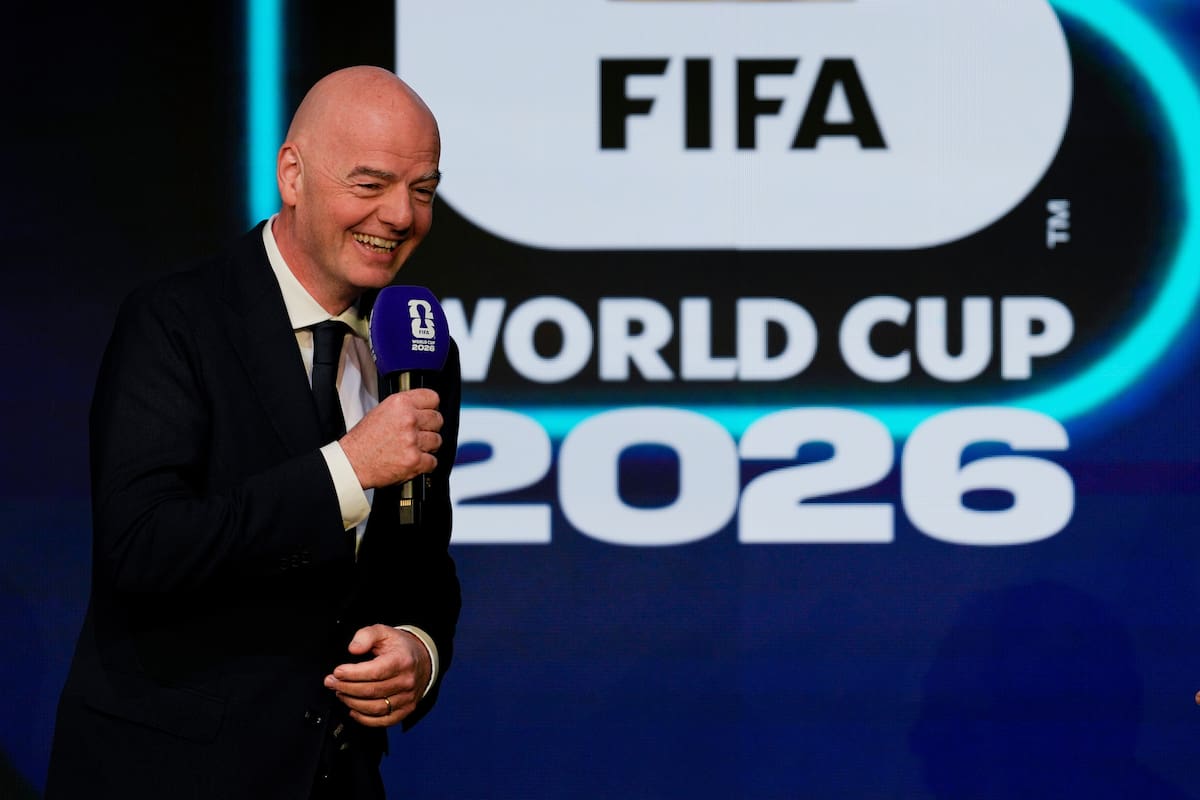
GENEVA (AP) — FIFA President Gianni Infantino already is in globe-trotting campaign mode more than five months ahead of the vote when 211 member federations decide who will lead the world soccer body until 2031.
The March election comes as Infantino faces the biggest leadership crisis since he took office in 2016, triggered by backlash against his now-withdrawn plan to sell private investors a stake in the commercial rights to the World Cup and other FIFA tournaments.
The FIFA leader has a busy travel schedule as the vote approaches. In the past two weeks his Qatari jet has criss-crossed the world, from Saudi Arabia to New York, across the Caribbean, to northern Europe, then central and South-East Asia, where he’s met at least 20 of the federations who will vote on March 18 in Morocco.
So where do things stand?
An Associated Press tally shows 87 of the 211 FIFA Member federations have indicated support for Infantino – either in individual comments or by endorsing statements of support by their regional confederations.
That puts him within reach of the simple majority he would need to beat a challenger, though none has stepped forward so far.
As of Tuesday, 49 federations, mostly in Europe, had come out against Infantino.
More than one-third of FIFA members have yet to announce their position, and much could change by March. A key date is the Nov. 18 deadline for intended rivals to enter the contest.
European soccer body UEFA, backed by the leadership of North American soccer body CONCACAF and the Asian Football Confederation, has promised to put up at least one challenger to Infantino. Who that would be remains unclear.
The issue is likely to be discussed as UEFA’s 55 member federations meet in Berlin this week.
UEFA has called on Infantino to step down, and many of its members have publicly withdrawn their support for him. But not all UEFA members have fallen into line — one of his top aides is from Azerbaijan, which has expressed continued support for Infantino.
Africa and South America are Infantino strongholds. In August, the executive committee of African confederation CAF “unanimously” confirmed its support for Infantino. However, it’s unclear whether every member will follow the CAF line in March. Most haven’t expressed their views publicly.
Infantino is expected to attend a CAF meeting in Cape Verde this week.
All 10 members of South American confederation CONMEBOL have endorsed Infantino including World Cup finalist Argentina . They want Infantino to expand the 2030 World Cup which would give South America more entries and more games to host. UEFA opposes that 64-team idea.
The Asian confederation AFC has joined the criticism of Infantino, but its members appear far from united. Former World Cup host Qatar has expressed support for the FIFA leader while Jordan has declared its opposition.
CONCACAF is also split with the U.S. and Canada among those opposing Infantino and Mexico coming out in support.
In Oceania, the Solomon Islands, Tahiti and New Caledonia have said they back Infantino, while New Zealand withdrew its support in August.
When the FIFA chief watched the World Cup final on July 19 at MetLife Stadium near New York, he had the support of nearly all FIFA member associations and there was little doubt that he would win re-election for a third term.
Just nine days later, media reports detailed Infantino’s talks with New York investor Josh Kushner – the younger brother of Trump’s son-in-law Jared Kushner - to create a FIFA subsidiary running tournaments like the World Cup.
A backlash led by European soccer and fueled by senior FIFA executives forced Infantino to drop the sell-off plan within four days. Since then, his leadership has been called into question by many European associations, who have withdrawn their support for him one by one.
UEFA even said it’s preparing a criminal complaint against Infantino over the investment plan. FIFA dismissed the legal moves as a “smear campaign.”
No sitting FIFA president has lost an election in the last 50 years. The ability to control and distribute World Cup profits now counted in multi-billions to member federations has always been a key advantage for the incumbent.
FIFA rules state candidates must have “played an active role in association football (e.g. as a player or an official within FIFA, a confederation or an association, etc.) for two of the last five years before being proposed.” They must have “declarations of support” from at least five of the 211 members.
In a ballot of two candidates, a simple majority of valid votes will win. With three or more candidates, a winning majority is “two thirds of the votes of the member associations present and eligible to vote.” The candidate with the lowest total in each round is eliminated until there is a winner with two thirds, or just two candidates left.
Across the world, some members have reason not to announce their voting intention. There is a long-time fear in global soccer politics of retribution for not backing the winner. Spain, for example, is unlikely to advertise its vote while competing with Infantino’s close ally Morocco to host the 2030 World Cup final .
See AP’s full soccer coverage here